

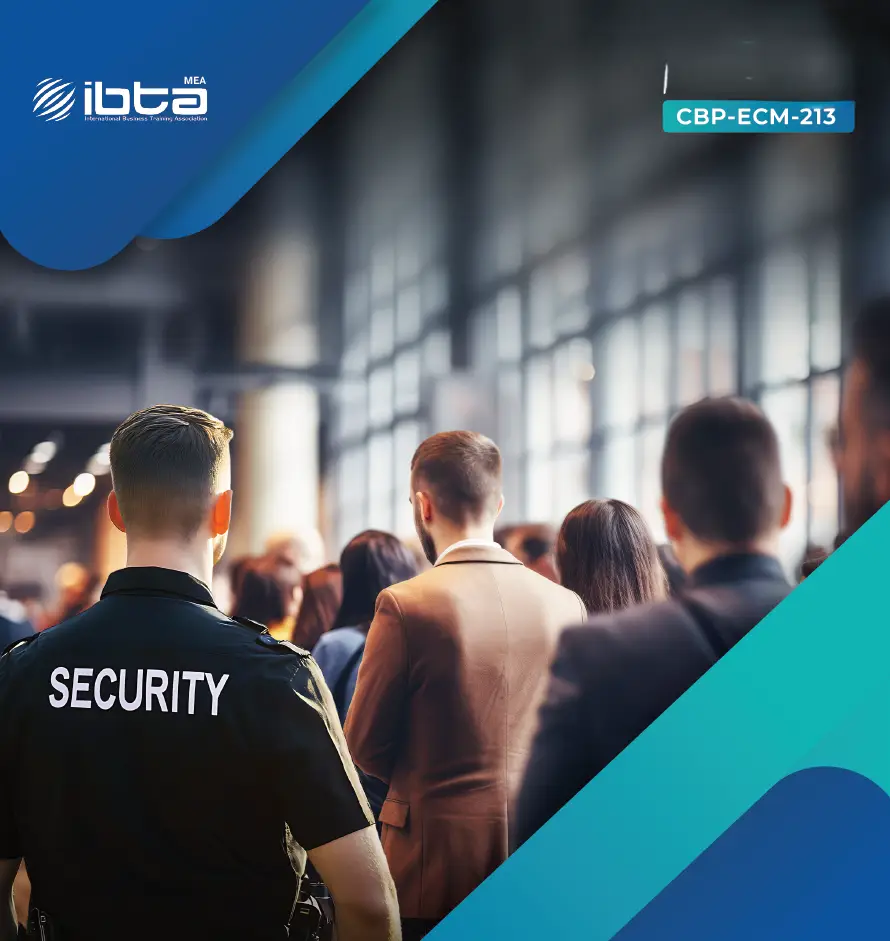
General View on the Program
The Events and Crowd Management Program aims to develop trainees’ capabilities in planning, organizing, and effectively handling events, crowd movement, and crowd flow across various environments—whether in major events, open spaces, or locations with operational sensitivity.
The program focuses on equipping trainees with skills to analyse crowd behaviour, predict congestion levels, and develop safe and well‑designed control plans within the context of event planning and execution, following global best practices and modern technologies.
The program combines science and theory on one hand, and practical application and simulation on the other, ensuring that trainees can make quick, accurate decisions capable of preventing risks before they occur.
Main Objectives
- Develop trainees’ ability to manage events efficiently and professionally.
- Understand crowd behaviour theories and crowd dynamics and apply them in event contexts.
- Understand the nature of crowds and the factors influencing individual and group behaviour.
- Prepare the general plan for event management.
- Plan event marketing campaigns and select appropriate channels.
- Design the attendee experience and link it to the institutional identity and objectives of the organizing entity.
- Prepare and manage event budgets.
- Design movement pathways and identify control points to ensure smooth crowd flow.
- Prepare organizational plans to control individual movement and ensure safety during events.
- Enhance the ability to manage risks and safety.
- Build the ability to coordinate with relevant authorities to ensure the application of best preventive practices.
- Develop emergency, evacuation, and safety procedures during events.
- Apply the principles of official protocols and ceremonies in event organization and VIP management.
- Apply negotiation and dialogue skills.
- Learn about modern technologies in event and crowd management.
- Apply artificial intelligence for analysis and prediction related to crowd behaviours.
- Analyse global and local events and extract best practices.
- Gain the ability to conduct practical simulations for crowd management in various environments.عة
Target Audience
- Individuals working in event organization.
- Employees in security and public safety sectors.
- Managers and supervisors of major events.
- Workers in tourism and hospitality sectors.
- Senior Managers of Shopping Centers and Entertainment Complexes
- Individuals interested in developing their skills in crowd management.
- Students and graduates of tourism and hospitality programs.
Duration of the program
- 25 hours
- Training hours may vary depending on the schedules of Certified Business Professional Centers.
Program Language
- Arabic language
What the trainees receive
Each trainee will receive a complete training package that includes:
- Student book.
- Course presentation.
- Activities for practicing course content.
- Pre‑ and post‑assessment tests.
It is also recommended to complete the following courses to gain integrated skills within this program:
- Communication skills.
- Problem‑solving and decision‑making.
- Effective leadership and team management
International Examination
International examinations for obtaining the Certified Business Professional in Events & Crowd Management (CBP‑ECM) certification are conducted through Prometric at approved testing centers. These exams aim to measure the level of professional competence, essential skills, and required proficiency for certification.
All certificates are issued and accredited by theInternational Business Training Association (IBTA), noting that the passing score is 70% or above. Candidates may study the CBP program and obtain the CBP‑ECM certification at any approved training center. For a list of accredited training centers,
Please visit our Website for more information: www.ibtamea.com
Training Program Contents
Unit One:
Fundamentals of Events and Crowd Management
Introduction to events and crowd management
Event management
Importance of crowd management in the success of events, conferences, and exhibitions
The integrative relationship between event planning and crowd management
Fundamentals of crowd behaviour and dynamics
Theories of crowd behaviour and mass dynamics
Understanding individual behaviours within crowds
Factors influencing crowd behaviour (psychological – social – environmental)
Elements of crowd dynamics
Crowd classification criteria
Defining characteristics and traits of crowds
Reasons for crowd formation
Types of gatherings that form crowds
Unit Two: Operational Planning for Events Using the 7Ps Model
Purpose – Objective
- Transforming the event objective into measurable outcomes
- Linking the objective to expected returns (financial / moral / institutional)
People – Target Audience
- Identifying the needs of different audience segments
- Distributing services based on audience type
- Managing the audience experience practically
Planning
- Preparing a comprehensive operational plan for the event
- Allocating financial and human resources
- Linking activities, time, and cost
Place – Venue
- Selecting the venue based on:
- Cost
- Operational requirements
- Estimating logistical costs
Promotion – Marketing & Promotion
- Preparing the event marketing plan
- Identifying promotional channels
- Estimating the marketing budget
- Monitoring registration and attendance
- Linking marketing to attendance rates and return on investment
Procedures – Operations & Execution
- Preparing operational procedures
- Organizing work among teams
- Controlling operations during execution
- Controlling expenses during operations
Post‑Event Evaluation
Evaluating overall event performance
Evaluating financial results
Measuring the impact of marketing campaigns
Unit Three: Spatial Planning and Organization for Crowd Management in Events
Main components of crowd management
Crowd management plans for major events
Analysis of different crowd types
Managing and guiding audience movement in real time
Studying the event site based on crowd management considerations
Analysing crowd movement patterns and flow
Designing movement pathways and identifying control points
Preparing crowd management plans and controlling crowd density
Unit Four: Protocols and Official Ceremonies for Events
Introduction to protocol and ceremonies
Basic rules of official protocol
Managing guests and VIPs
Organizing official ceremonies for events
Protocol in international and multicultural events
Unit Five: Field Management of Crowds During Events
Roles and responsibilities of crowd management teams
Reading crowd behaviour and immediate response
Handling critical situations
Managing difficult behaviours
Crowd environment and audience experience
Real‑time field monitoring and taking corrective actions
Improvement plans
Unit Six: Leadership and Negotiation Skills in Events and Crowd Management
Leadership and motivation skills for event and crowd management teams
Dialogue and negotiation skills
Problem‑solving and decision‑making
Handling pressure
Effective communication (verbal and non‑verbal)
Unit Seven: Risk Management and Safety Assurance in Events
Importance of crowd management in ensuring safety and protecting audiences during events
Potential risks facing crowds
Identifying and assessing potential risks
Developing emergency and evacuation plans
Safety and security procedures before and during events
Joint coordination with relevant and supporting authorities
Unit Eight: Modern Technologies in Events and Crowd Management
Advanced monitoring and control systems
Counting, tracking, and density‑management technologies
Instant alert and communication systems
Artificial intelligence applications for predicting crowd behaviour
Unit Nine: Evaluation and Practical Application
Case studies from around the world (successes – failures – lessons learned)
Simulation exercises for various scenarios
Preparing and developing crowd management plans for participants
Practical application for preparing a crowd management plan
Evaluating plans and improving procedures according to best practices